Many employees drift between roles without a clear path, which can lead to burnout, turnover, and hidden talent gaps. Aligning career planning with business strategy turns this risk into a competitive advantage. When companies shift from reactive to proactive talent development, they unlock higher engagement, lower recruiting costs, and stronger internal mobility. This article recasts career planning through an explicitly business lens, showing how AI enhances planning at scale to deliver measurable corporate value.
Unilever: Structured Career Frameworks and Internal Mobility
Unilever has long invested in proactive career planning, emphasizing structured frameworks and internal mobility. Their Future of Work initiatives upskill employees to future-fit capabilities, guided by a strategic skills map and aligned projects, gigs, and mentorship. (Unilever, 2021). This approach boosts internal mobility and retention, contributing to meaningful work and higher productivity. Forbes also reports a notable productivity improvement tied to flexible, internal career opportunities (Forbes, 2021).
AI’s role in business value is to make this framework predictive and scalable. By continuously analyzing skill gaps with machine-learning techniques and graph-based skills adjacency, AI can forecast future-critical gaps and align learning investments with business priorities (WE360.ai, 2025). Using both internal data and external labor-market trends, AI helps leadership anticipate skill needs tied to strategy, reducing time-to-competency and enabling faster deployment of talent to high-impact projects.
Skills Maps, Power Retention, and Performance
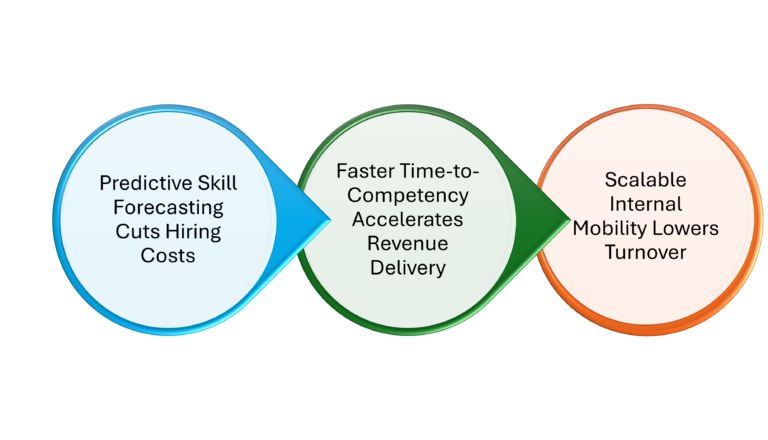
Unilever’s proactive career frameworks and Future of Work initiatives already yield tangible gains for the company, and AI supercharges these outcomes by transforming career planning into a predictive, scalable engine aligned with business strategy, such as:
- Predictive Skill Forecasting Cuts Hiring Costs: Machine learning analyzes skill gaps using graph-based skills adjacency, blending internal performance data with external labor trends. This helps resource managers in finding the ideal people for certain tasks, slashing external recruiting expenses and reducing time-to-fill roles (Afrin, Islam & Zand, 2023)
- Better Talent Deployment: AI continuous gap analysis aligns learning investments with business goals, shortening ramp-up for critical projects. The AI models can ingest multiple data sources and automatically infer skills each employee has, and doesn’t have, for future-ready competencies (Eastwood, 2024). Instead of spending months on assessments, organizations can get accurate insights that contribute to revenue acceleration.
- Scalable Internal Mobility Lowers Turnover: AI matches talent to gigs and projects proactively, fostering retention without over-recruiting. A study from the University of Baghdad shows that AI plays a pivotal role in minimizing turnover as well as employee retention by maximizing fairness and accuracy for internal promotion and job allocation (Journal of Local Self-Government, 2025). This builds a resilient internal talent market, cutting vacancy costs and preserving institutional knowledge
- Risk Mitigation for Strategic Agility: AI tools support decision-making around risk response strategies and automate mitigation action, enabling real-time risk sensing, which becomes a competitive advantage for the company (KPMG, 2025).
In short, Unilever turns career planning from an HR cost center into a profit lever. This consequently results in higher productivity, lower churn, and faster strategic execution, all measurable via reduced headcount spend and accelerated project ROI for the company.
Conclusion: From Career Planning to Profit Levers
Other companies can emulate this AI-enhanced career framework by starting with structured skills maps, gigs, projects, and mentorship to boost internal mobility and retention, proven to drive productivity gains. In addition, the company can also layer in AI for prediction by using machine-learning with graph-based skills analysis to blend internal data and labor trends, forecasting gaps tied to business priorities like tech upgrades or expansion.
The payoff is clear: Hiring costs and process can be reduced by slashing time-to-fill, which in turn accelerates revenue delivery. The plan is to pilot on one team, measure via dashboards, then scale company-wide to turn talent planning into a profit lever.
How a Platform Can Support Business Outcomes
CXS Analytics helps organizations build clear, skills-based career pathways using integrated psychometrics and AI workforce analytics. The platform supports personalized career growth, strengthens internal mobility, and helps retain and develop future-ready talent, directly tying career planning to business outcomes.
Ready to drive measurable business impact with AI-enabled career planning? Contact us to book a demo.