In a recent study by Spencer Stuart, 37% of boards admitted to delaying CEO succession because they lacked a ready internal candidate. This isn’t just an HR problem; it’s a strategic crisis that weakens momentum and dilutes investor confidence. Yet most organizations still treat succession planning as a reaction to exits, rather than ensuring leaders are ready before gaps happen. In reality, the work should be done long before that point, so the next leader is already in place when needed.
Many companies still rely on fragmented information and subjective judgment, which leads to late transitions and roles sitting unfilled longer than they should. The cost of reacting late shows up quickly. Decisions slow down during key transitions. Companies fall back on expensive external hires. And leadership handovers often lack continuity. This is where workforce analytics is changing things: by creating a single, real‑time view of leadership readiness, organizations can start preparing successors before gaps affect performance, rather than reacting when leaders depart.
Enabling Proactive Succession Planning Through Workforce Analytics
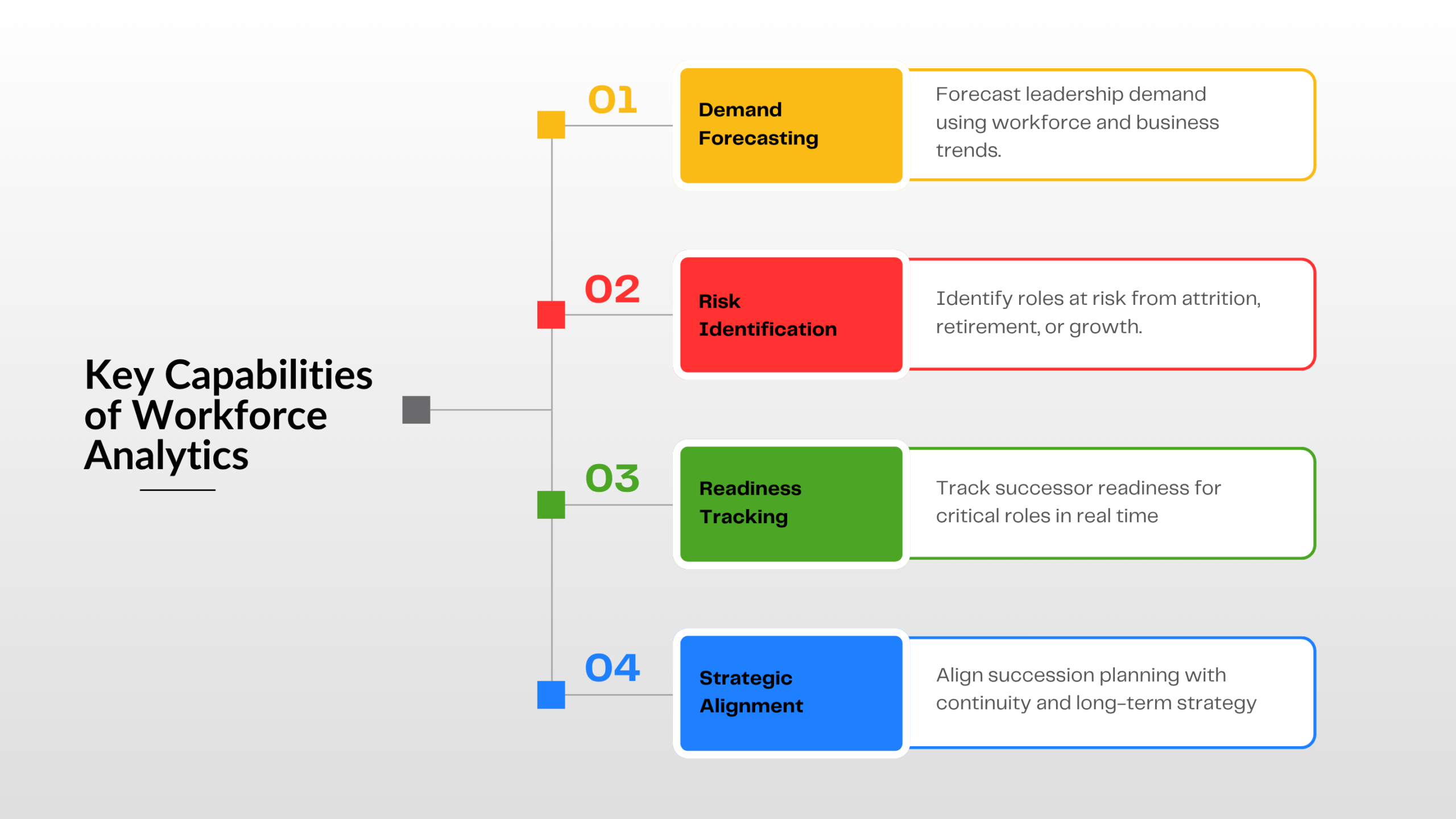
Proactive succession planning starts by identifying leadership risk early, before it becomes disruptive. McKinsey found that organizations using people analytics are 1.5 times more likely to outperform their peers—largely because they make better, earlier decisions about talent. The shift starts by integrating fragmented HR and skills data into a single, real-time view of leadership readiness. This allows organizations to:
- Detect early signs of attrition in key roles.
- Uncover skills gaps at the leadership level.
- Assess leadership readiness more consistently than subjective reviews allow.
Research shows that organizations using people analytics can achieve up to 80% improvement in recruiting efficiency and 50% lower attrition. This means critical roles are flagged as at‑risk long before they sit empty, and successors are in development before they are needed.
Making Leadership Decisions with Data, Not Assumptions
“20–30% of critical roles are not filled by the most suitable candidate”
Improving succession planning starts with one shift: visibility. Organizations need a centralized view of leadership-critical skills and existing workforce capabilities. This creates clarity on where strengths exist—and where gaps are emerging.
With this view, companies can:
- Plan targeted learning plans to close critical skill gaps.
- Reinforce strengths where employees already excel.
- Personalize development to changing role needs.
Progress can be tracked across defined readiness stages—whether someone is ready now or in 1–2 years. This allows organizations to build proactive succession pipelines supported by targeted development, rather than waiting for a crisis. Predictive analytics also helps by reducing unconscious bias and limiting the influence of informal networks or politics, reinforcing more transparent, skills‑based decision‑making. Deloitte’s Global Human Capital Trends notes 7 in 10 leaders view real-time AI analytics as essential, with adopters seeing 1.6x stronger returns.
Accelerating Leadership Readiness Through Internal Mobility
Internal mobility plays a critical role in accelerating leadership readiness by translating potential into real-world capability. Rather than relying solely on static development plans, organizations can use workforce data to identify high-potential talent and strategically deploy them into cross-functional or business-critical roles. Research by LinkedIn shows that employees who make internal moves are 75% more likely to stay, reinforcing the value of mobility in building sustainable leadership pipelines.
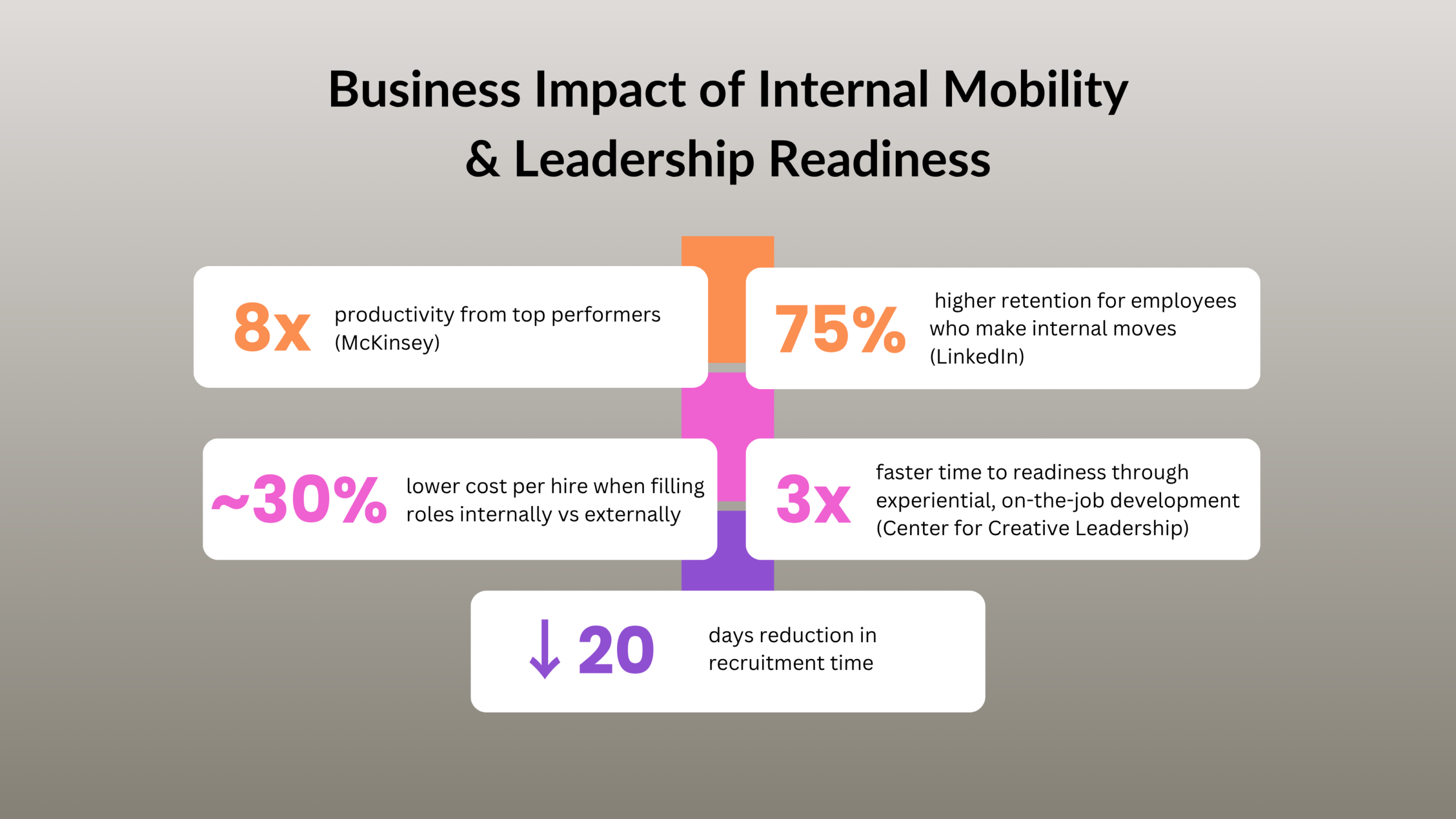
Project-based assignments take this further by placing emerging leaders in real, high-stakes environments. These short-term, targeted opportunities not only expand skill sets but also provide more observable indicators of leadership readiness beyond traditional performance metrics. With top performers shown to be up to 800% more productive than average, ensuring the right leaders are ready at the right time becomes a direct driver of business performance.
By aligning internal mobility and career pathways directly with succession priorities, organizations can ensure that development efforts are intentional and role-relevant. This creates a more agile leadership pipeline, ensuring critical roles are filled quickly without disrupting business momentum.
Case in Point: Schneider Electric
Schneider Electric implemented an AI-powered internal talent marketplace to strengthen internal mobility and leadership development across the organization. By improving visibility of skills and matching employees to internal roles and projects, the system enables faster movement of talent into critical positions. This approach reduces dependency on external hiring while building a stronger, more cost-efficient leadership bench. This has translated into measurable outcomes at scale:
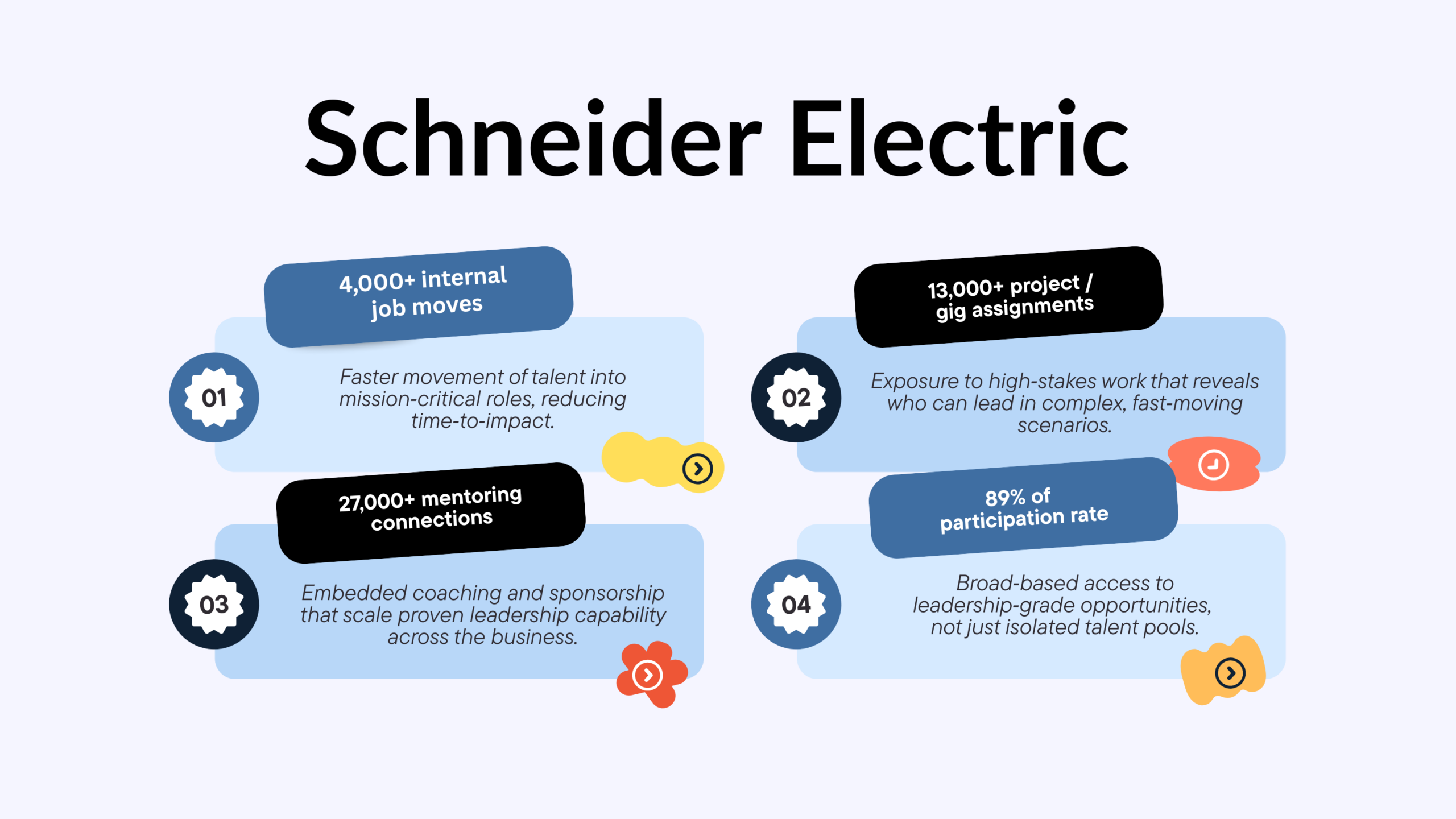
By turning these thousands of gigs and mentoring connections into observable data points, Schneider Electric isn’t just matching jobs—they are actively stress-testing and verifying their next generation of leaders in real-time.
From Reactive Succession to Continuous Leadership Readiness
Analytics-driven succession planning helps reduce leadership disruption, cut executive hiring costs, and improve decision-making continuity across the business. This reduces the risk of board interventions or special‑meeting drama when a CEO or C‑suite role is unexpectedly exposed. Organizations that use data and AI for workforce planning are better prepared to build steady, future-ready leadership pipelines instead of reacting when gaps appear.
Hope is not a succession strategy. Stop reacting to leadership gaps and start architecting your transitions. Contact CXS Analytics to audit your talent pipeline today.