
Internal Mobility: Why Gen Z Is Changing the Game
Gen Z has stepped into the workforce with expectations that are very different from the generations before them. Now making up roughly 27% of the talent pool, they are not interested in waiting for the next step on a traditional promotion ladder. They want to grow, explore new roles within the company, and see where their career could take them.
And when those opportunities aren’t there, they don’t wait—they will move on to the next roles and organizations.
- 77% have lost talent due to weak career development.
- Only 1 out of 4 companies feels confident in their internal mobility strategy (Aptitude Research, 2023).
These numbers are not just statistics. Yet despite the interest in internal mobility, many companies still rely heavily on external hiring. McKinsey shows that organizations without strong internal pathways often lose their highest-potential talent first (McKinsey & Company, 2022). With Gen Z projected to become the largest working group by 2035, this challenge will only become more urgent.
So what is creating this persistent mobility gap?
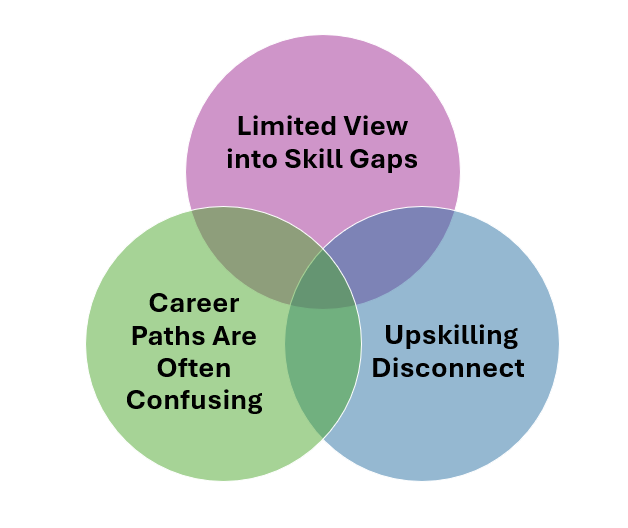
Limited Views into Skills Gap Traits
Internal mobility ultimately depends on two things: knowing the skills you already have and building the skills you need next. When either one is weak, mobility will start to stall. Many leaders already know skill gaps exist, but few can pinpoint them clearly.
- 87% of companies acknowledge having skill gaps (McKinsey & Company, 2021).
- 38% of employees may require substantial reskilling within three years (MIT CISR, 2024).
So the issue isn’t awareness, it’s visibility.
A Skills Library gives organizations the structure they need to make that visibility real. It shows:
- Skills employees currently have
- Skills the organization still needs
- Skills that should be developed next
When organizations pair this visibility with an internal talent marketplace and career-pathing tools, they get a much clearer view of their workforce. Managers can spot potential earlier, employees understand their options, and mobility becomes more dynamic.
The impact? Faster internal placements and fewer external hires. Studies show that internal roles are typically filled almost two weeks faster than external ones.
Career Paths are Often Confusing
When companies talk about career paths, the idea usually sounds good on paper. But if you ask employees, they often don’t know their next step. In many cases, it’s genuinely easier for someone to find a role at another company than to move internally. A lot of skills just stay hidden within teams, almost like they’re “locked in managers’ closets” (Bersin J., 2019). This isn’t surprising, considering how most HR systems are built.
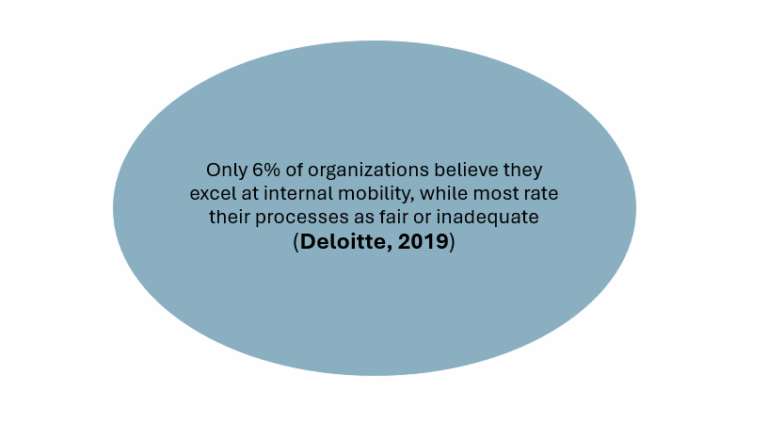
- Only 6% of organizations believe they excel at internal mobility, while most rate their processes as fair or inadequate (Deloitte, 2019).
This is where AI and an internal talent marketplace help close the gap. AI highlights roles that genuinely fit an employee’s strengths, while the marketplace makes internal opportunities visible and easy to act on. Together, they transform mobility from a guessing game into a transparent pathway. Internal movers have a 75% likelihood of staying for two years. Once companies gain this visibility, the next step is ensuring employees can actually build the skills required for those opportunities. This is where many upskilling efforts still fall short.
Upskilling Disconnect
Many businesses know internal mobility matters, but their upskilling efforts often don’t match what employees actually need. People who want to move into new roles can’t always see which skills matter most. So when an opportunity appears, the person who could have taken it isn’t ready—not because they lack potential, but because the learning they received wasn’t tied to real roles.
In an AI-driven workplace, this gap feels even bigger. New skills are emerging quickly, and younger employees want chances to build capabilities that will keep them future-ready.
Here’s the reality behind that disconnect:
- Only about one-third of companies have a formal internal mobility program.
- Companies that do connect learning with real mobility pathways see real gains—23% more internal movement and 57% higher retention.
When upskilling is aligned with actual role requirements, everything works better:
- Employees transition into new roles sooner
- Skills gaps close faster
- Talent retention improves
How CXS Analytics Supports the Careers Gen Z Wants
For Gen Z, career growth isn’t about climbing a ladder—it’s about movement, learning, and opportunities. Internal mobility is what gives them that. When companies highlight clear routes forward and back it up with real development, Gen Z feels supported, not stuck. And when they feel supported, they stay.
CXS Analytics turns internal mobility from a concept into a real, visible path employees can move toward. With our Internal Talent Marketplace and Career Pathing tools, you can build the mobility experience today’s workforce won’t just appreciate, but stay for.
Ready to unlock real internal mobility? Talk to our team or explore our solutions now.