
5 Workforce Trends Shaping 2026: What Business Leaders Can Anticipate
As we enter 2026, workforce strategy is no longer something leaders can delegate entirely to HR. It has become a board-level issue, not because it is trendy, but because business performance depends on how effectively organizations mobilize their people to deliver results.
Many organizations fail to optimize their existing workforce, causing skills to sit idle, roles to remain rigid, and internal talent to be underused. In this article, we outline five workforce trends that will shape how C-suite leaders allocate talent, control costs, and execute strategy in 2026 and beyond.
1. Solving the Asset Visibility Crisis
The single largest source of leakage in the P&L isn’t headcount; it is asset underutilization. Leaders may assume they know their talent inventory, that is until a critical role opens and projects are delayed, costing time and revenue. When leaders lack visibility into existing skills, they double-spend on contractors for capabilities they already have.
AI-powered talent marketplace make this setback easily solved by helping leaders identify who can be promoted, moved laterally, or deployed to priority projects. Companies that map skills and move people internally can build productivity significantly.
Unilever’s FLEX, an AI-powered marketplace where employees can try short-term projects and grow new skills without having to change jobs. This program has improved productivity by 41% and collaboration by 21% (IMCR, 2021). More recently, Unilever reported that its focus on internal expertise drove productivity gains across three out of four sites, delivering an average improvement of 27% between 2020 and 2024 (Unilever, 2025).
The lesson? Always look inside first.
2. Cost Efficiency & Internal Velocity
External acquisition is a high-cost, high-risk strategy. In 2026, internal velocity; the speed at which employees can be redeployed to new priorities will become a key lever for margin protection. Research from Josh Bersin shows that external hires can cost three to five times more than moving talent internally.
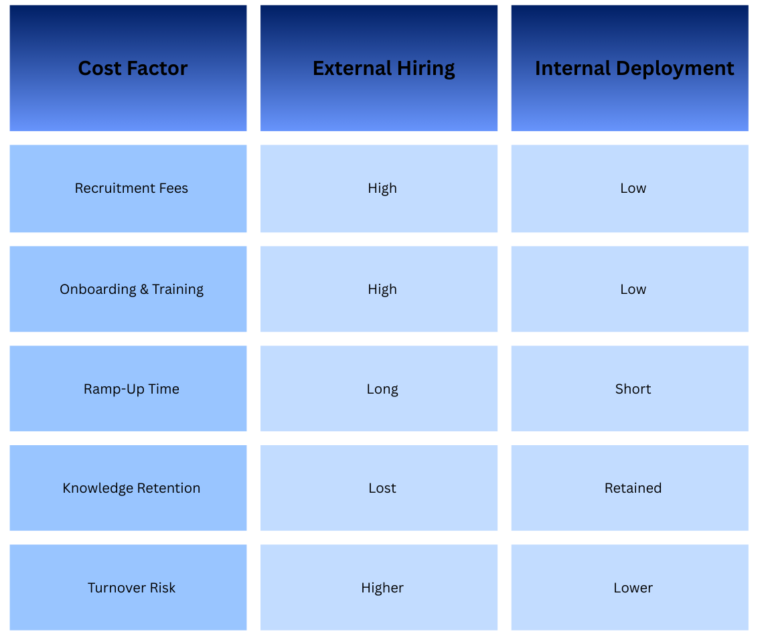
Internal marketplaces match talent to open roles quickly, reducing hiring delays, maintaining operational continuity, and maximizing internal capacity. Faster mobilization lowers turnover costs, improves productivity, and frees leaders to focus on growth. (Magnit Global, 2025). In practice, promoting from within can reduce recruitment time by up to 20 days, as employees tend to stick around longer, which helps keep teams stable.
3. Reducing Time-to-Value
Projects stall when the right skills are not available at the moment of execution. Continuous learning is no longer about employee development in isolation; it is how organizations deliver results faster. When employees build skills in line with real work, organizations shorten time-to-value.
AI-driven learning platforms personalize development around current skills, interests, and business demands, replacing one-size-fits-all career paths.
AT&T’s Future Ready program and Personalized Learning Experience (PLE) ensures skills are built as work gets done, closing the gap between strategy and execution. The organization offers online courses to help the employees learn new skills (CNBC, 2018).
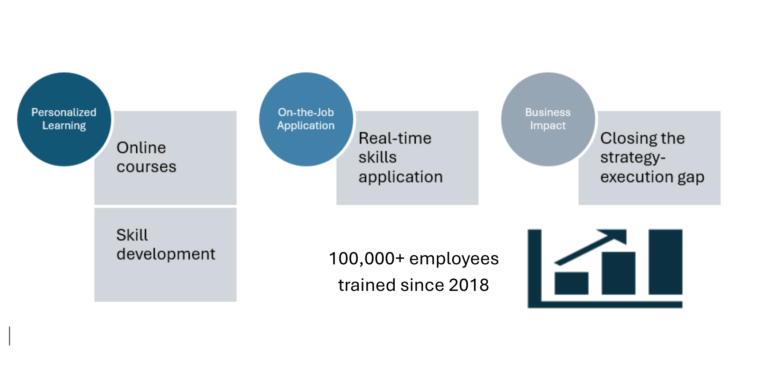
By investing in their people, AT&T ensures employees can develop their skills while making a real impact on the company’s goals, closing the gap between plans and results; converting talent into measurable business impact.
4. Building an Agile Operating Model
Rigid job architectures are the enemy of speed. In a volatility-rich market, the ability to deconstruct jobs into skills and redeploy resources instantly is a competitive moat. By 2026, C-suite leaders must recognize that traditional, title-based roles no longer align with rapidly shifting business priorities. Organizations that fail to address this risk will move too slowly, miss critical opportunities, and incur higher costs through avoidable outsourcing.
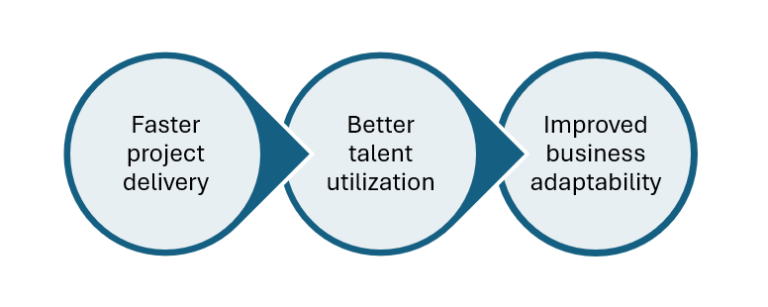
Focus on skills, not just job titles. Mapping skills and forming flexible teams supported by AI-driven skills libraries and talent matching allows organizations to deploy work quickly without relying on external hires. Research by McKinsey & Company shows skills-based deployment is more predictive of performance and retention than traditional role-based models. The result is faster execution, better use of existing talent, and greater adaptability as business priorities shift.
5. Mitigating Leadership Risks
Leadership bench strength remains a top concern for executives, but many fail at this. In too many cases, succession planning is unclear, leaving no successor when it matters. The impact can be seen fast, with projects getting delayed, revenue plummeting, and leaders being forced into costly external hires. Designing visible pathways for your employees can strengthen bench strength and reduce reliance on individual performers. Visible career pathways are not an engagement perk; they are a business continuity mechanism.
- Gaps in execution: While succession planning is widely recognized as important, many organizations admit they struggle to put it into practice effectively (Deloitte, 2018).
- Key-person dependency: Relying too heavily on a small number of individuals weakens bench strength and increases organizational risk.
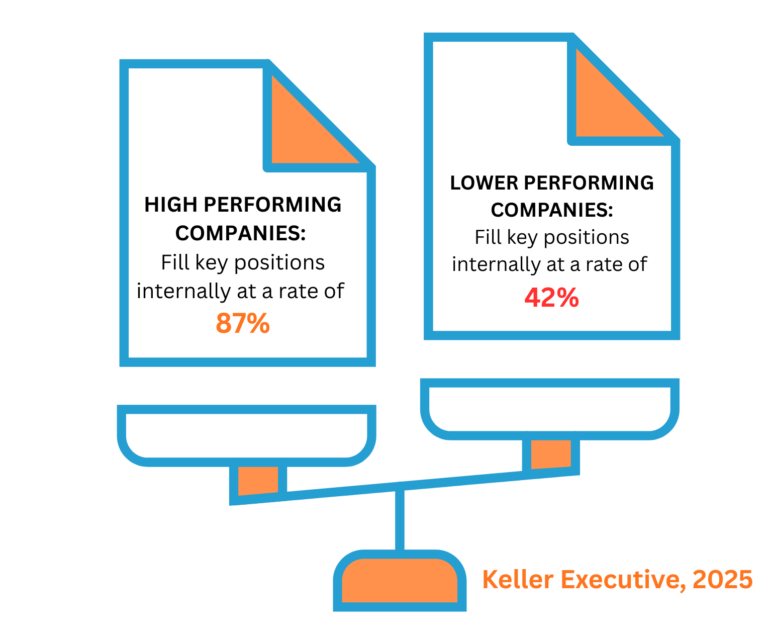
Identify talent ready to step up, give them the right experiences, and plan ahead before a role becomes critical. Companies that take this approach fill nearly 9 out of 10 key roles internally, compared with less than half for those that don’t, turning succession planning into a measurable business advantage. (Keller Executive, 2025)
Start 2026 with Clear Priorities
In 2026, competitive advantage will not come from hiring more people. It will come from deploying existing talent faster, with less friction. Leadership teams that succeed will:
- Make skills visible
- Move talent internally by default
- Replace rigid roles with flexible deployment
- Treat succession as risk management
The questions leaders should be asking are direct:
- Where critical skills actually sit?
- Can talents be redeployed as fast as strategy changes?
- Are leadership pipeline planned?
CXS Analytics helps leadership teams gain clarity on skills, internal capacity, and succession risk so workforce decisions support execution, not slow it down. Contact us now to book a demo.