
Bench Strength: Overcoming Succession Planning Struggles
True business continuity isn’t about replacing people, it’s about preparing them. That’s the essence of having strong bench strength. As described by TTM Associates, bench strength is the organisational capability to draw from a rich internal talent pool to fill crucial positions without experiencing performance loss (TTM Associates). Both succession planning and internal mobility are two main strategies that are used to ensure a strong bench strength and talent pipeline in the company.
However, in a company, we sometimes view individuals as indispensable, making the bench strength weak and ultimately the talent pipeline too. Key team members should be redundant, not indispensable.
One of the biggest mistakes organizations make is taking the copy-and-paste method, meaning ‘Let’s just hire more of the same,’ But with strategic alignment, you’ll find building a solid bench strength is more imperative to develop focus on the organisation instead of only replacing the talent you have today (McGuckin, 2025). Ultimately, having a strong bench strength reflects readiness, not redundancy.
This article will explore the struggles of having weak bench strength and ways to mitigate these problems in your company.
Fixing the Talent Pipeline Gaps
An alarming number of leaders fail spectacularly after succeeding their predecessor, although they are supposedly well-groomed for the jobs. Take a look at Coca-Cola’s M.Douglas Ivester. He became the CEO after Robert Goizuta’s death and was forced to resign after causing a serious slide in the company’s share price and terrible PR moves. Although he was accomplished in management, his lacklustre performance in public relations and managing acquisitions was what ultimately led to his downfall (Conger & Fulmer, 2003). The problem wasn’t the shoes of the departed being too big; it’s that succession planning is too narrow to uncover the right skill gaps that could easily derail even the most promising candidate.
The biggest challenge is that HR does not have the right tools to fix the talent gaps at a granular level. With AI-powered talent intelligence, we can now gain a better understanding of the skills associated with talent, making it easier for HR to track career progression in real-time (Cerrato, 2023).
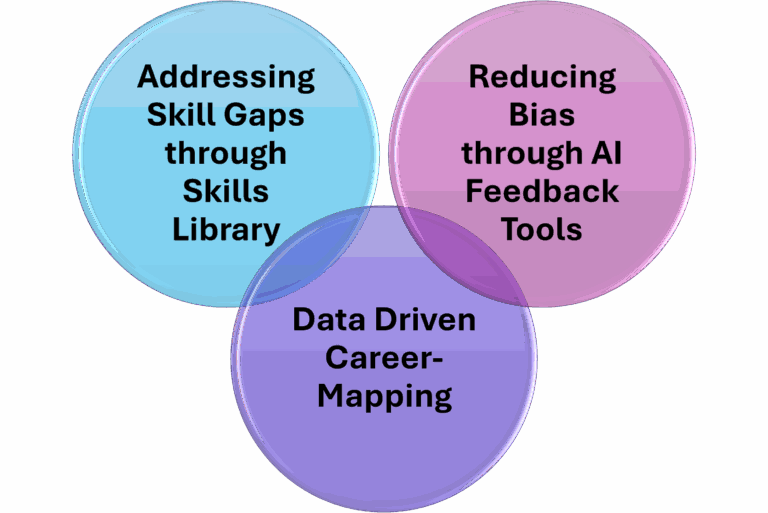
Features such as Skills Library are important for understanding what’s happening to the talent within the organizations, and in Ivester’s case, his lack of public relations skills. In addition, Deloitte claims that utilising AI for skills development has reduced the skills gaps among employees by 40% and the number will only continue to grow as more companies adopt AI tools in their skills development (Deloitte, 2024)
The Cost of Leadership Reluctance
One of the quickest ways to damage an organization’s bench strength is hindering employees’ internal growth through leadership’s reluctance, especially among high performers. This practice is so common that there’s a term for it—high performer curse (The Influence Journal, 2025). There’s a resistance from leaders to moving high performers internally, fearing productivity loss in current roles.
This can be alleviated through AI-powered workforce simulations. Through its Predictive Analytics Tools, AI enables companies to see the long-term organizational gain of internal mobility versus short-term role disruption (Changeassociates, 2024). In addition, Data-driven Career Mapping demonstrates clear ROI, helping leaders make more confident mobility decisions. Leveraging these tools has shown tangible benefits, up to 40% faster critical roles placement and 30% to 50% increase in internal mobility (Sridar, 2023), simultaneously making the company’s succession planning more efficient.
Bias & Visibility Issues
According to McKinsey analysis, between 27 to 46 per cent of executive transitions bear disappointing results after two years, reflecting a staggering failure of succession planning in general. The mistakes were due to the predecessor oversight and similarity bias, as people are more likely to view a candidate favorable if they believe they think in a similar way that they do (McKinsey, 2025). To build a bias-free leadership bench, a company can start by establishing an unbiased successor evaluation.
In a research experiment using AI to employyees, the process tends to focus more on skill and knowledge, while bias was reduced by ~41.2 % (Mujtaba, Mahapatra, 2024). This can be achieved through AI, anonymous 360 feedback tools can be utilised, including competency benchmarking and cultural alignment scoring to eliminate bias.
These AI features add objectivity to what is often a highly emotional decision and reduce the risk of biased decision-making (Global Law Expert, 2025). As data becomes more readily available and accessible with AI, it needs to play a bigger role in succession planning as opposed to leaders relying too heavily on intuition.
Technology Amplifies, Not Replaces.
Ultimately, the essence of any workforce strategy is about realizing human potential; the same goes for succession planning and reinforcing your company’s bench strength. Although some may cast AI and its analytics as technological silver bullets, AI is meant to strengthen human understanding, not substitute it.
With CXS Analytics, succession planning is made smarter and simpler with AI-powered efficiency. Ready to improve your hiring? Contact us and book a demo today!