
Beyond Numbers: Aligning KPIs with Organizational Goals Through AI
In today’s fast-moving business landscape, companies’ Human Resources often struggle to keep pace with evolving strategies. One of the most critical challenges lies in how Key Performance Indicators (KPIs) and performance management systems are designed, tracked, and aligned with organisational goals. This is also worsened by the proliferation of disparate Human Resources Information Systems (HRIS) that created multiple challenges around system integration, cross-functional visibility, and data fragmentation (Kingsley, 2025). To overcome these obstacles, organizations are increasingly turning to AI-driven Balanced Scorecards (BSCs) that dynamically align KPIs with strategy by solving their limitations.
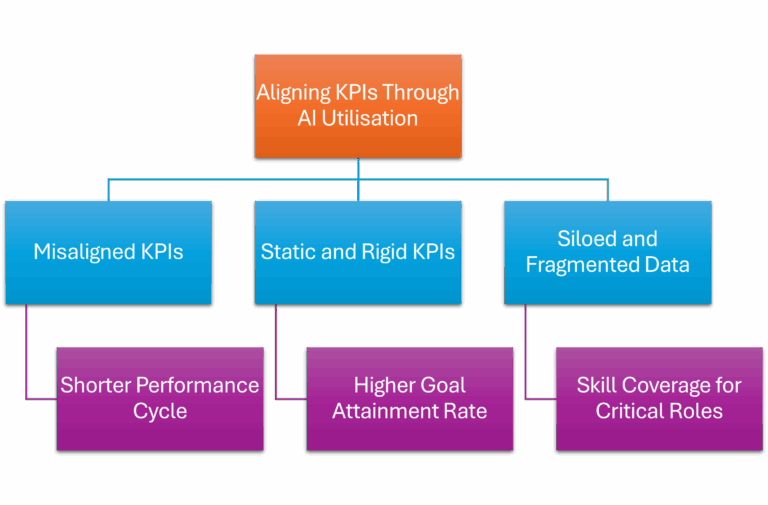
Misaligned KPIs and Dynamic Mapping
Firstly, misaligned KPIs remain a significant obstacle to achieving long-term impact. Many organizations design KPIs that focus on immediate tasks rather than strategic priorities, resulting in employees meeting their targets without contributing to overall business outcomes. According to Segato, this might be caused by a concept called Data Paralysis. The abundance of data leads to decision-making delays, ineffective utilization of data and therefore, misaligned KPIs that are often made based on limited analytical knowledge and low levels of confidence (Segato, 2025).
By introducing dynamic KPI mapping powered by AI within a BSC framework, companies can ensure that KPIs alignment remains strategic. This reduces the need for constant manual recalibration while making sure every individual and team goal contributes to broader organisational success. For instance, leveraging machine learning through predictive analysis assists in forecasting future outcomes. Incorporating AI in BSC helps answer questions such as, “When is the optimal time for a discount to drive sales to your customer database?” (Segato, 2025) The outcome is a more efficient performance cycle where results are both measurable and meaningful. This can be supported by a study by Rožman, Oreški, and Tominc (2023), who reveal that organizations supported by AI have a shorter performance cycle, as it helps in enhancing the VUCA (volatile, uncertain, complex, ambiguous) environment.
Static and Rigid KPIs Structure
Secondly, traditional KPI structures are often static and rigid, usually reviewed only once a year. In fast-changing industries, this approach leaves employees working towards outdated or irrelevant targets. As stated by Shieldbase, KPIs that are updated on fixed cycles create a reactive culture, where the company will only respond once the results are in. In a fast-paced market, this becomes a liability (Shielbase, 2025). AI-enabled BSC systems address this issue by continuously tracking performance data in real time, automatically flagging obsolete metrics, and recommending more relevant ones. Another transformative AI trend on the rise is Prescriptive KPIs. Unlike traditional KPIs, AI-enabled BSC recommends specific actions, from adjusting pricing to changing market spend.
This adaptive approach ensures KPI alignment to evolve alongside shifting business priorities, promoting organizational agility and keeping performance management relevant at all times. BCG stated that companies reviewing and adjusting their AI KPIs saw 2x better alignment with business outcomes as compared to those doing annual reviews (BCG, 2024). Therefore, when static and rigid KPIs are assisted with AI-enabled Balanced Scorecards, organizations gain the agility to continuously adapt performance metrics to real-time business conditions, and this constant recalibration empowers employees to focus their efforts on objectives that truly matter. Ultimately, organizations experience a higher goal attainment rate, since every performance target is both relevant and strategically meaningful to the company.
Siloed and Fragmented Performance Data
Thirdly, siloed and fragmented performance data creates significant blind spots for HR and leadership teams. According to Kingsley, modern enterprise is rarely a monolith in managing the HR system. Employee data might be stored on Workday, performance review on Lattice, and Talent acquisition on the other hand is operated through Greenhouse (Kingsley, 2025). While this might help in choosing the most effective tools for the company, it also adds up to fragmented data, resulting in a patchwork of KPI alignment that lack cohesion. When data is scattered across HRIS, CRM, and project management systems, it prevents a holistic view of individual and team performance.
AI-driven dashboards integrated into the BSC solve this problem by consolidating disparate data sources into a unified performance view. The inputs from IoT devices, CRM systems, ERP platforms, and external data sources replaced the traditional model of waiting weeks for performance reviews (Shieldbase, 2025). In addition, powerful AI tools such as machine learning (ML), natural language processing (NLP), and deep learning further help with automatisation of data extraction, analysis, and integration across siloed systems, addressing messy data fragmentation with accuracy (Georgiou, 2025). With a single source of truth, organisations gain clearer insights into workforce capabilities. This not only simplifies analysis but also highlights skills gaps in critical roles, allowing HR to proactively identify skills gaps and deploy strategies to fill critical roles, ensuring that the right talent is placed where it matters most.
Optimising Your KPIs with CXS
To summarise, an optimised KPI framework delivers measurable improvements across the organisation. Performance reviews are completed faster as cycle times decrease, reducing administrative burdens and allowing leaders to focus on strategic priorities. Next, KPIs are dynamically aligned to business goals, and employees are empowered to hit more targets, leading to higher overall goal attainment. Lastly, the clarity of performance insights also supports internal mobility by making it easier to identify and redeploy talent into critical roles where their skills are most needed.
Let’s make your KPIs smarter, faster, and more strategic. Reach out and contact CXS to explore AI-powered performance solutions today!